The Need
A wall-mounted AC unit cools the room it hangs in — and nothing more. Wherever adding another unit is impossible or not worth the cost, the cool air simply never arrives. The sharpest example is the sukkah: a temporary structure beside the house where an air conditioner cannot and may not be installed — and during a holiday that falls at the end of summer, sitting in it gets very hot. The idea: instead of adding an air conditioner, take the cool air from the existing one and lead it where it is needed.
The Engineering Solution
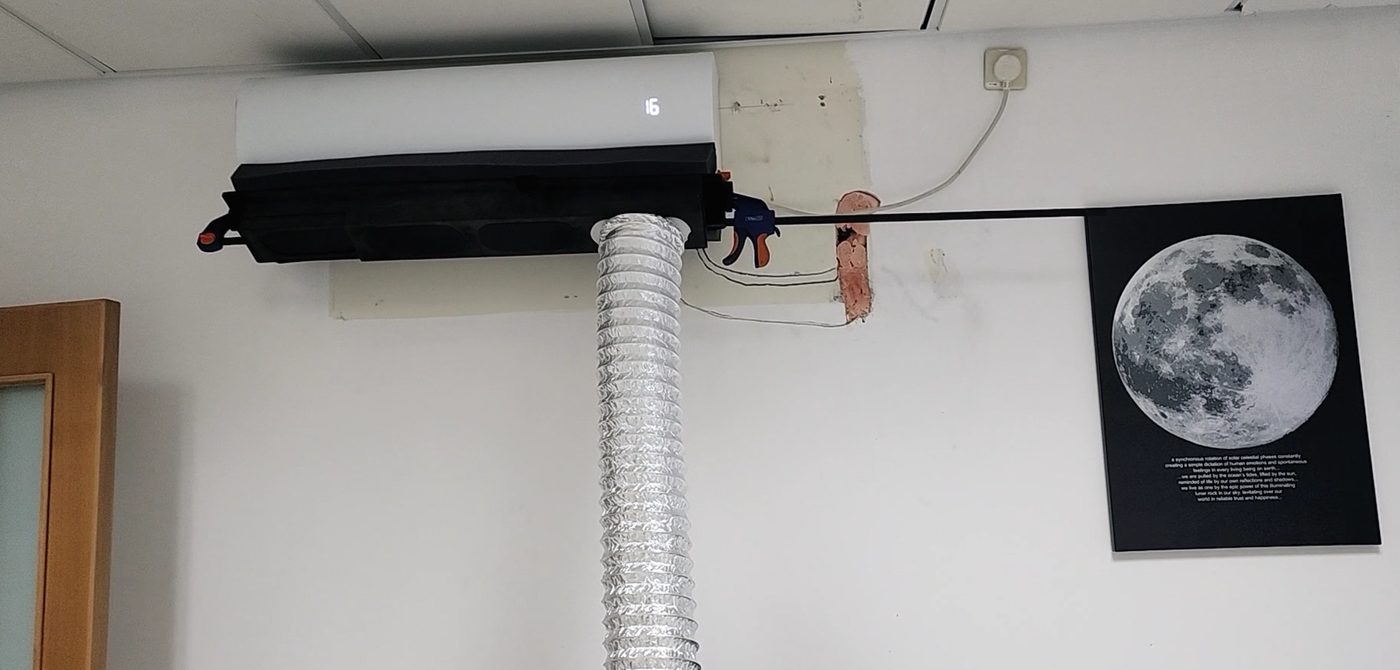
The system grips the body of the AC unit without harming it: a truss of rails with a clamping mechanism holds the indoor unit and captures part of the outgoing airstream into a duct. From the duct, a flexible corrugated hose carries the air to an adjacent room, a hallway, or out to the sukkah. Installation and removal take minutes, with no special tools and no modification to the air conditioner — a critical point for a product meant for seasonal use.
Three Design Decisions That Set the Product's Cost
- Off-the-shelf parts wherever possible: the clamping mechanism, flexible hose, and connectors are based on existing, inexpensive components instead of custom development. Fewer unique parts means fewer molds — see the cost logic in new product development.
- Extrusion instead of injection molding for the long parts: the main rails are extruded — a process whose tooling costs far less than an injection mold, and where length adds little cost. Only the small parts are slated for injection molding — trade-offs we cover in manufacturing technologies.
- Universal fit: wall-unit widths run from roughly 29 to 53 inches across common models. The rails adjust across that whole range, so a single product version fits nearly every home — a must for a consumer product sold without custom fitting.
A Working Prototype
The first step in the project was exactly what we recommend to every inventor: a quick proof-of-concept built from available components, proving the principle on a real air conditioner before investing in full design — that is the prototype in the photo above. The model confirmed the key question: the airflow arriving at the end of the hose is genuinely felt, and installation is simple enough. We expand on this approach in our prototyping articles.
What It Demonstrates
This is a product born from a precise understanding of a defined audience — tradition-observant families who need a cooling solution for the sukkah — and engineered from day one around the shelf price that audience will pay. Defining the audience before the design is what set every manufacturing decision, a path we map in idea to product. The next stage for a project like this is production preparation — molds for the small parts, an extrusion profile for the rails, and a pilot run.
Have a product idea shaped by a specific audience? Contact Projects House through the form and let's take it from idea to shelf.